The planned Process
and how it didn't work out
3/25/20263 min read


How should the production process work? My personal goal was simply to re-record the songs in radio-quality. Lacking a band, the AI takes on the role of the other musicians, both in contributing ideas and playing the instruments.
However, some research indicates that Suno's quality doesn't quite reach radio quality; only proper mastering and detailed processing of the individual tracks would achieve that. Why?
The AI (i.e., Suno, Mureka, and others) doesn't create music as individual instruments, even if it sounds that way. It creates it as a complete work. You can download stems (individual tracks) from the platforms, but these are only extracted automatically from the complete track. You can regenerate individual passages and even individual instruments in the studio section of the websites. But when you create a song, it's always initially a single, complete file. This severely limits the influence you can have on the final result. So what can you do?
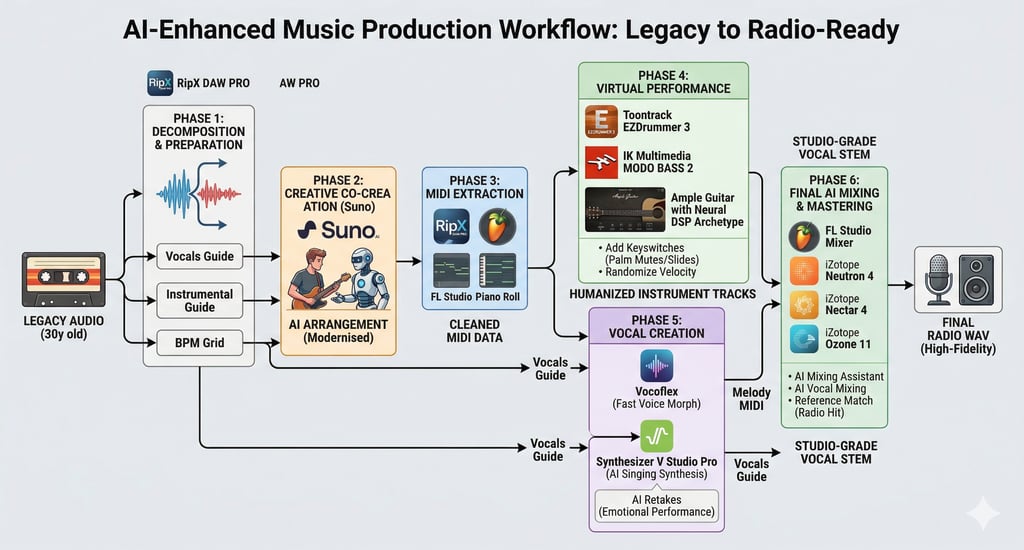
The best approach would be: First, the old tracks are separated from the vocals using RipX (a slightly better alternative to SpectraLayers). This gives us a pure instrumental track. This track is then reworked with Suno and given the desired creative enhancements. A separate file with new vocals is also created based on the lyrics, but the melody is generated by AI. The result is then returned to RipX to separate the individual instruments and convert them to MIDI format.
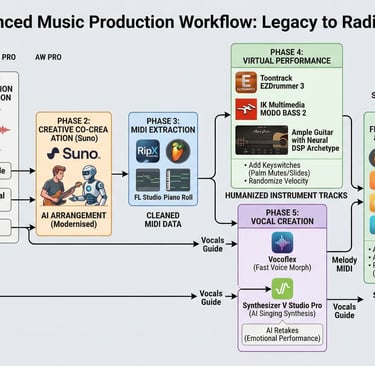
The MIDI files are loaded into FL Studio, my DAW, and enhanced with virtual instruments using plugins like EZDrummer, MODO BASS 2, and Ample Guitar. This allows for significant control over the sound. Finally, professional-sounding vocals are added using Synthesizer V Studio Pro. Everything is then mastered with iZotope, and voilà: a finished, radio-quality music file. This is how it should look:
I'd rather not even calculate the total cost. You need a Suno subscription to get enough credits and the rights to the material. Then there's the software: FL Studio, RipX, and Synthezizer V Studio Pro. And finally, the plugins for the instruments and for mastering. Why mastering? Because I can't master at all. I suffered a blast injury to my left ear when I was 19 and have severe tinnitus. I enjoy listening to music, but I don't have the hearing required for proper mastering. iZotope offers AI-powered automation for this with its plugins. But I can't even use FL Studio very well. So, I switched to the Groove3 platform, got a subscription, and gained access to a lot of learning material on mixing, mastering, and FL Studio.
However, my first attempts were completely disheartening. Even the separation with RipX proved to be a complete failure. The sound of the instruments was simply too difficult to separate. There are many notes that don't belong to the actual instrument, and the MIDI files are practically unusable. Every track has to be painstakingly cleaned up manually, meaning it has to be re-notated. The guitars are a major problem, because RipX can't separate the rhythm and lead. So, in effect, I have to reverse-engineer the song and capture it as sheet music. That's where I reach my limits. The AI was supposed to save me time, but this process is taking up a huge amount of time. Even getting the instruments to sound really good in FL Studio without playing them manually is a huge undertaking. Also I'm wondering: The AI Support is there but the Music - except the vocals - is ultimately not AI created. It's hand work, like I've done it already before.
So the result for me was: I will not recreate the Music as a Midi notation. I will use Suno to create as much as possible, mix and master it with the imperfect Stems and add what might be needed. The vocals could be added via Synth V or directly in Suno. I will decide this later. So let's go for the first Song.
Contact
Telefon
© 2025. All rights reserved.
Alternative music in an alternative way.